
Bottom line
1. Neolabs have $56B of confirmed funding, and Prometheus has a third of it. Another $12B has been reported but not confirmed by the companies.
2. About two-thirds of that money will go to compute. This is my estimate. Labs building language models will spend about 70% of their funding on compute. Robotics labs will spend 44% and science labs 36%, because robots, data collection and wet labs take the rest.
3. Neolabs rent their compute. Of the 22 labs that have named a provider, seven use Google Cloud. Mistral is the only one building its own capacity at scale.
4. The gigawatt deals are paid for by someone other than the lab. Thinking Machines has a deal with Nvidia for at least 1 GW. Its confirmed funding rents about 23 MW for three years.
Fifty labs, $56B
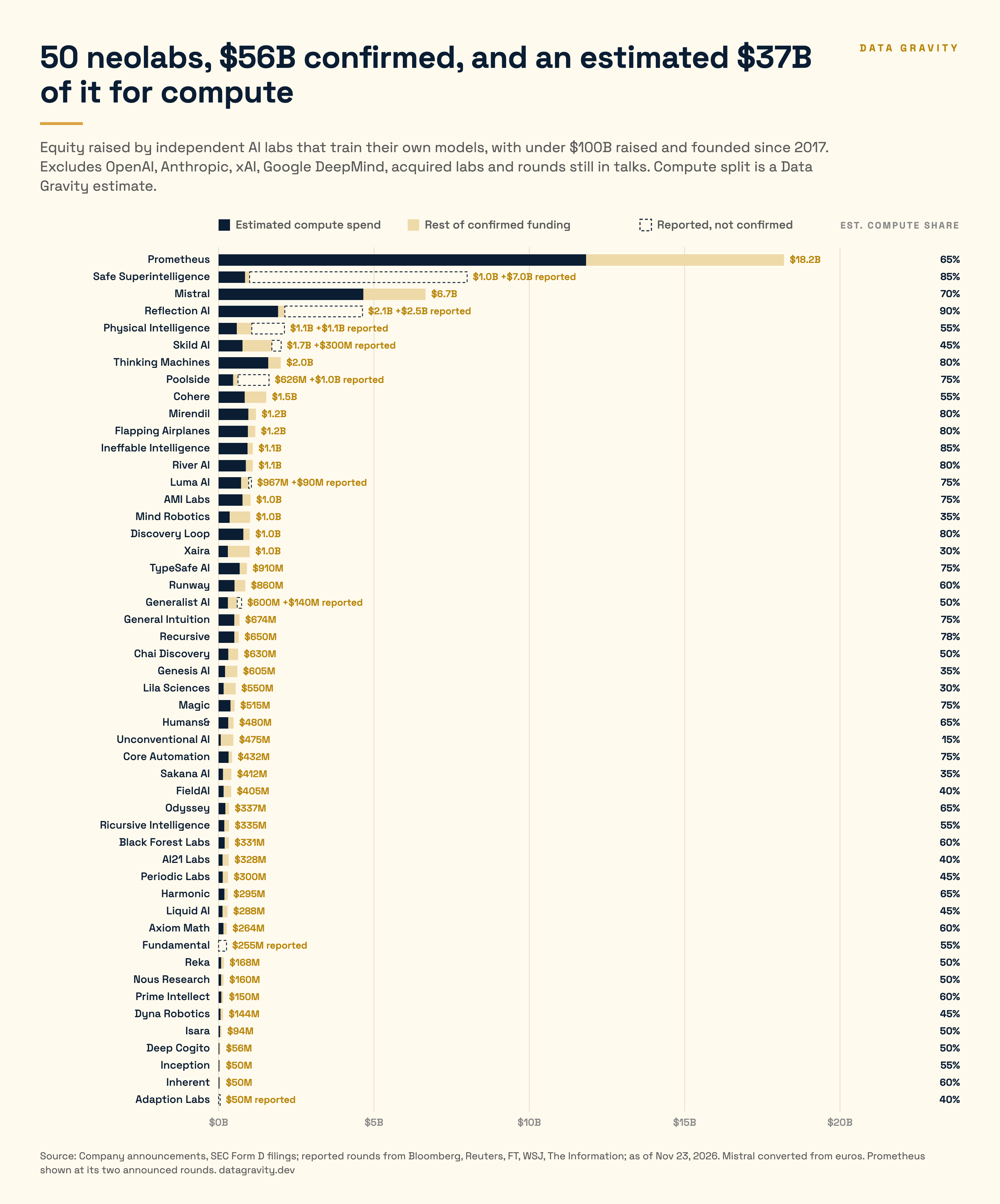
I counted every independent lab that trains its own models and has raised at least about $50M. I left out OpenAI, Anthropic, xAI and Google DeepMind, labs that have been acquired, and Chinese labs.
A round counts as confirmed if the company announced it, filed it with the SEC or confirmed its size. On that basis the 50 labs have raised $56B. Rounds like SSI’s $2B in 2025 and Nvidia’s investment in SSI this July have been widely reported, but SSI hasn’t confirmed the amounts. Those are shown separately and add $12B. Rounds that are still in talks are excluded, including Thinking Machines’ reported $5B.
Most of the money is recent. The labs closed $30.6B in 2026, more than in every earlier year combined.
Two labs dominate. Prometheus, the industrial AI lab co-led by Jeff Bezos, announced $6.2B at launch and $12B in June. Mistral has raised about $6.7B. Together they hold 44% of the confirmed total. Below them, 14 labs have raised between $1B and $2.1B each, most within a year of founding.
Two-thirds goes to compute
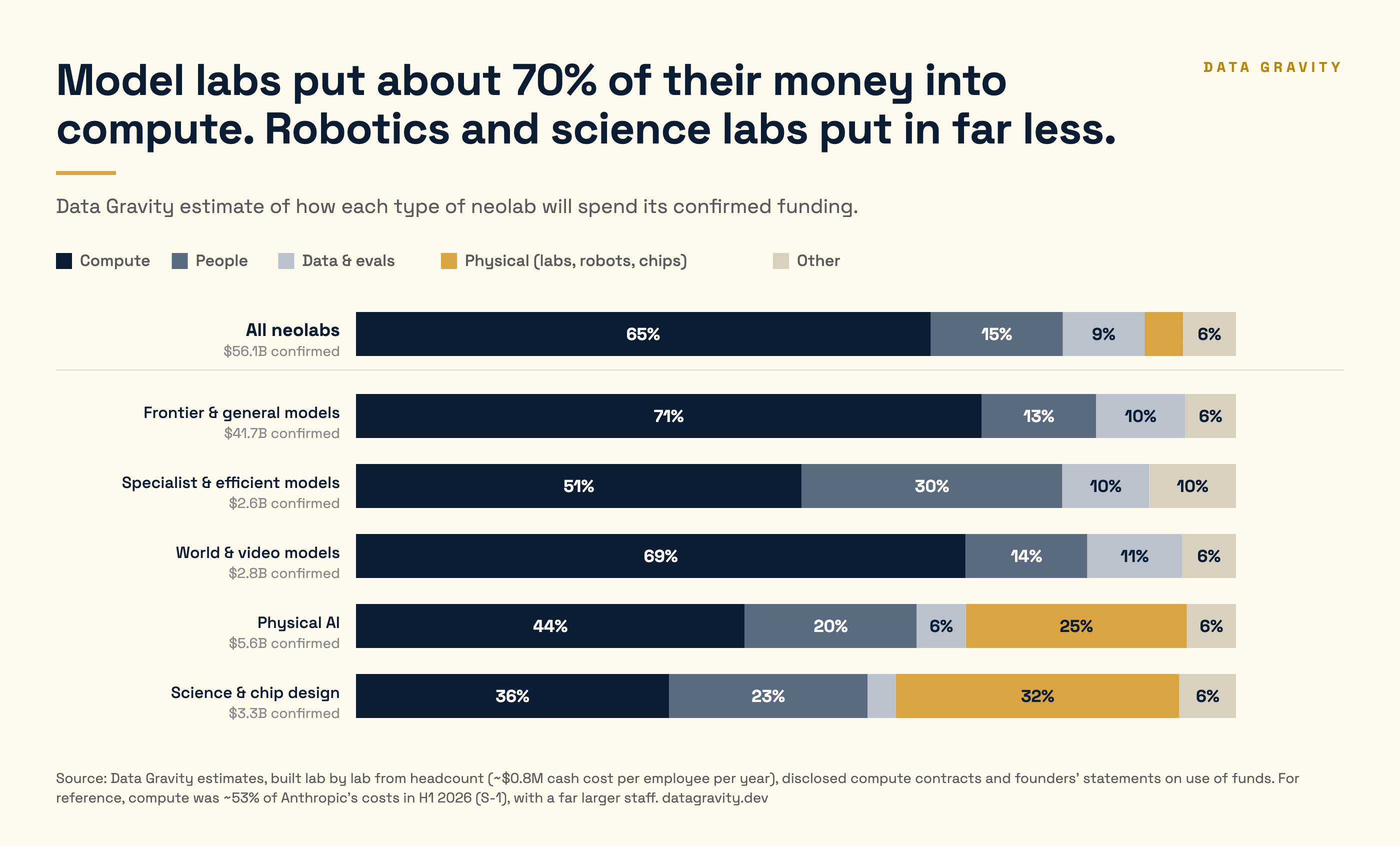
No lab publishes a breakdown of where its money goes, so I estimated each one. The main input is headcount. Neolabs are small: Recursive had fewer than 30 people when it raised $650M. At about $0.8M per person per year in salary, benefits and office, a 50-person lab spends $120M on people over three years. Against a $1B raise, that is 12%.
Disclosed contracts back this up. Recursive’s $410M deal with AWS equals 63% of its funding. Nebius announced a contract with Reflection worth more than $1B, and CNBC reported a separate Reflection deal with SpaceX at $150M a month through 2029. Together those exceed Reflection’s $2.1B of confirmed equity.
Founders say the same thing. Humans& co-founder Andi Peng said the lab “will spend the majority of the capital on compute.”
Anthropic offers a reference point. Its S-1 shows compute at about 53% of costs in the first half of 2026. Anthropic employs thousands of people and runs a large sales team. Neolabs employ dozens, so more of each dollar goes to compute.
The exceptions are labs with physical work. Lila Sciences runs automated wet labs. Genesis AI pays a workforce in sensor gloves to collect training data and builds its own robots. Unconventional AI designs its own chips. For these labs, compute is closer to a third of spend.
They rent, mostly from Google
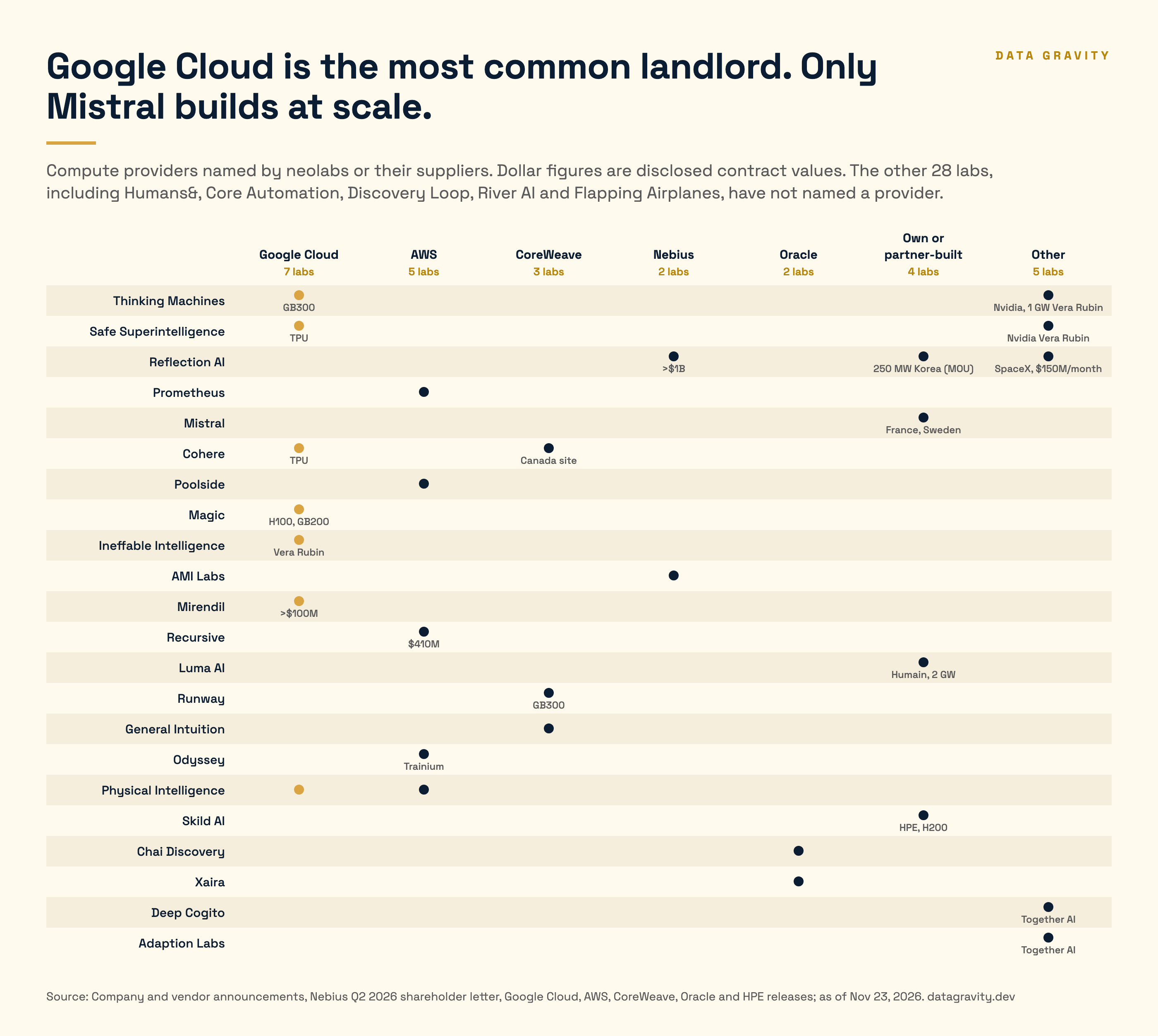
Twenty-two labs have named where their compute comes from. Google Cloud leads with seven, offering TPUs to SSI and Cohere and Nvidia GPUs to Thinking Machines, Magic and Ineffable. AWS has five, including Recursive’s $410M deal. CoreWeave has three.
Mistral is the one lab building at scale. It took an $830M bank loan to buy 13,800 Nvidia GB300s for a site south of Paris, committed €1.2B to a data center in Sweden, and agreed in July to rent part of its capacity to Microsoft.
The other 28 labs, including Humans&, Core Automation, Discovery Loop, River AI and Flapping Airplanes, have not said where their compute comes from.
The gigawatt deals are someone else’s money
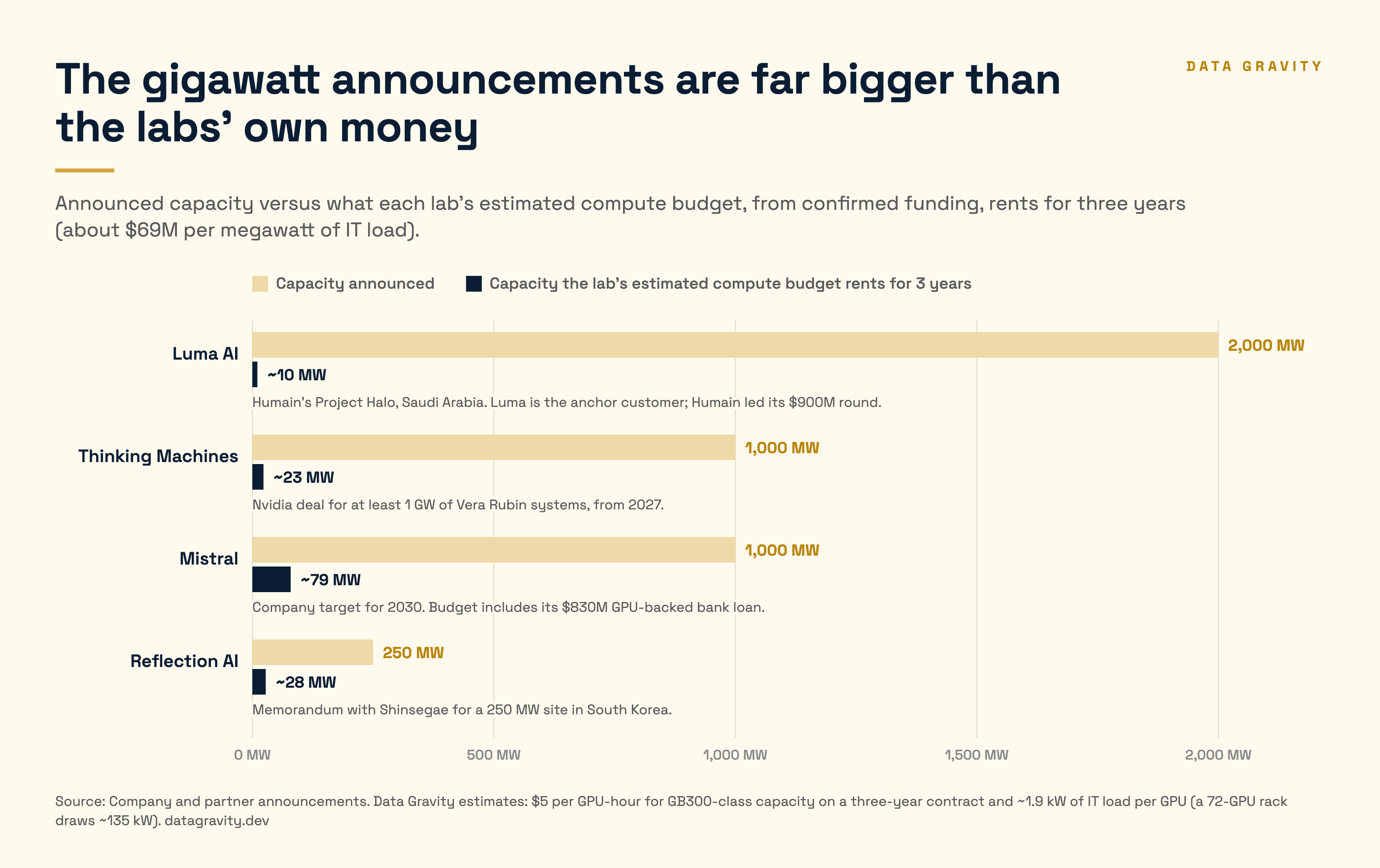
At $5 per GPU-hour, a megawatt of GB300-class capacity costs about $69M to rent for three years. At that price, the compute share of Thinking Machines’ $2B of confirmed funding rents about 23 MW. If its reported $5B round closes, that rises to about 80 MW. Its Nvidia deal is for at least 1 GW of Vera Rubin systems starting in 2027.
Luma is the anchor customer for Project Halo, a 2 GW cluster that Saudi Arabia’s Humain is building. Luma’s own compute budget rents about 10 MW. Humain led Luma’s $900M round. The investor, the landlord and the builder are the same company.
These deals get financed by the supplier or the sovereign, with the lab’s name on the announcement. Nvidia is an investor in more than half of the 50 labs and supplies the chips in most of the disclosed deals. Much of the money it invests comes back as chip purchases.
Half of Anthropic’s next year
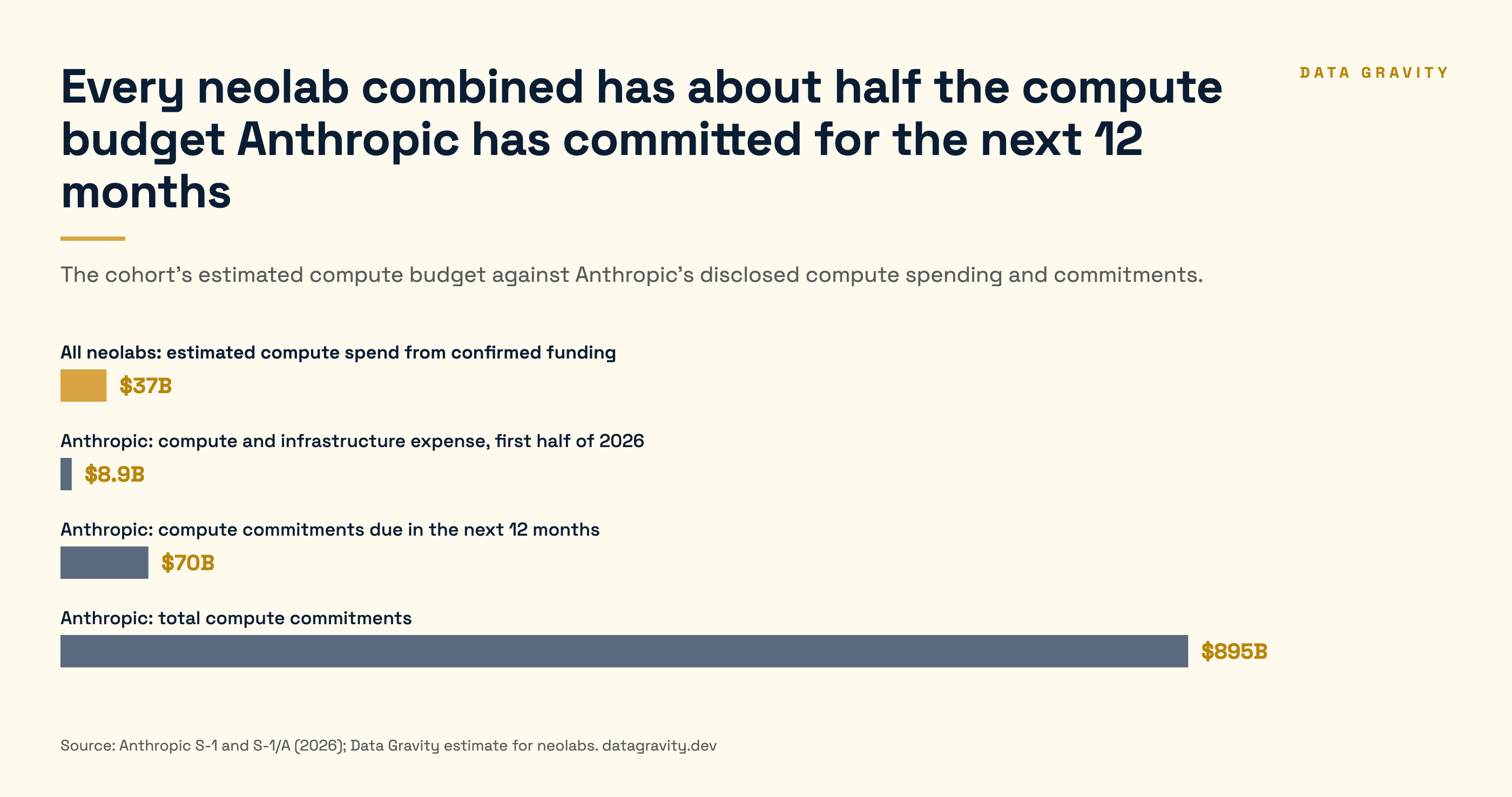
Anthropic’s S-1 shows $69.8B of compute commitments due in the next 12 months and $895B in total. All 50 neolabs together have an estimated $37B to spend on compute over the life of their funding.
So neolabs cannot win by out-spending the big labs. Each one is betting that a different method gets more out of less compute. If the bet works, a few dozen megawatts is enough. If it doesn’t, the lab needs a much bigger raise or a buyer.
The buyers so far sell chips and cloud. AMD closed its $8.2B purchase of World Labs this month; it was already an investor and World Labs trained on AMD GPUs. Amazon agreed on Nov. 23 to buy Decart’s optimization technology and team. A lab that cannot outspend the big labs is worth most to the companies selling them compute.
What to watch: whether Thinking Machines closes its reported $5B round, how large Cohere’s Series E turns out to be (it announced a first close without a size), and who pays for Reflection’s compute contracts, which already exceed its confirmed funding.