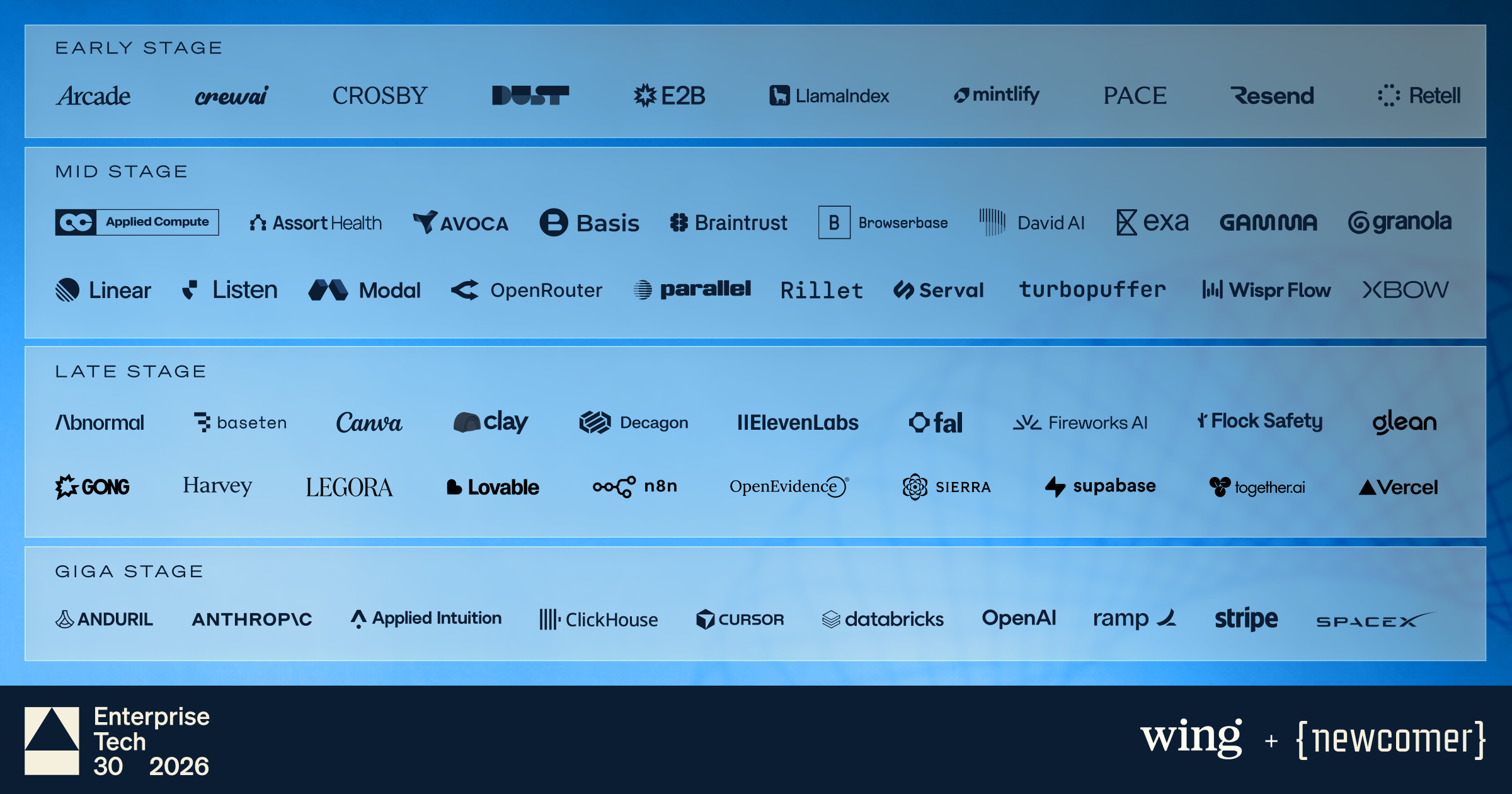

Welcome to the eighth annual Enterprise Tech 30!
For new readers, the ET30 is the exclusive annual list of the most promising startups in enterprise technology. Startups are leading the AI and agentic supercycle, and the ET30 represents one of the most comprehensive and data-driven research processes for evaluating and ranking privately held companies.
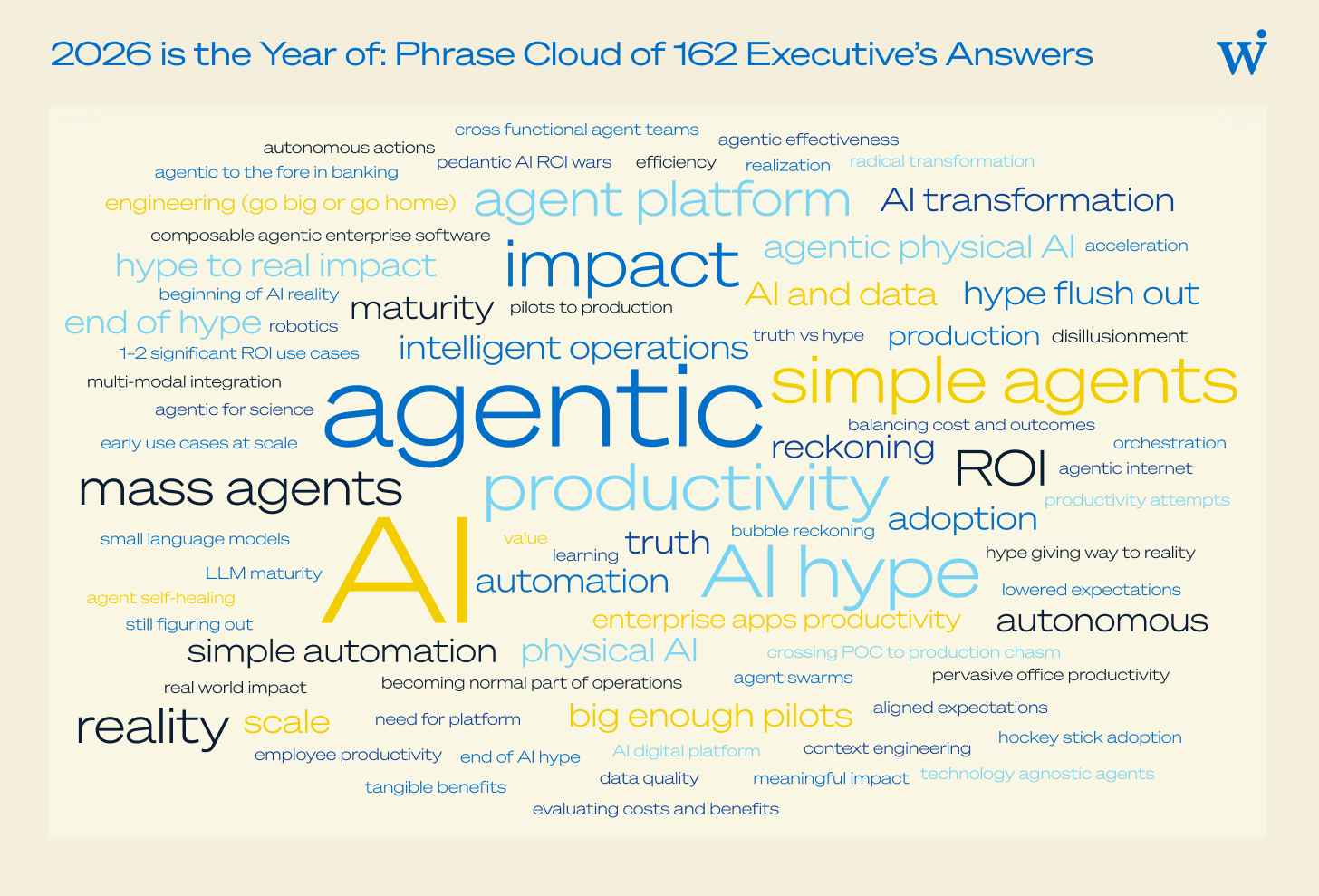
Wing was founded in 2013 on the belief that data and cloud computing would together constitute a new technology paradigm for business. This turned out to be more true than even we imagined, and it massively understated the case. The availability of large-scale computation acting on unprecedented data volumes made AI a practical reality for the first time. The result is far more than yet another ‘next big thing’ in tech. The AI transformation extends well beyond the scope of individual businesses, and well beyond the technology sector; it is reshaping vast swathes of the global economy and even society.
Many dimensions of AI transformation are well represented in the 2026 ET30, which is a revealing and forward-looking reflection of where we are (or soon will be) in the AI and agentic supercycle.
The key themes for this year’s ET30 are:
Rise of the Agentic Developer.
The ET30 consists of numerous companies assisting in the building of AI agents. Companies such as Braintrust, Browserbase, and Parallel are building agentic platforms and tools for professional developers, and companies such as Dust, n8n, and Retell are offering no-code agent builders for the general workforce. The Agent Development sub-category in the ET30 this year includes nine companies, many of which were founded only a few years ago.
Explosion of AI Agents.
It’s always been our thesis, informed by history, that infrastructure precedes the emergence of applications. In addition, there’s usually a hero experiment that shows everybody what’s possible. ChatGPT was that example for AI applications, and Claude Code is that example for AI agents. The AI Agents and Applications category in the ET30 this year includes 16 companies that span productivity, customer service, go-to-market, finance, IT service management (ITSM), enterprise resource planning (ERP), and more. We’re clearly entering a period where there is enough infrastructure and precedence for AI agents to be built and scaled.
The Vertical Comeback.
It was not long ago that venture capitalists saw industry verticals as startup killing fields. The conventional wisdom was that you couldn’t make money, and there were precious few examples of large, enduring companies that had been built. Now, a growing body of evidence shows that AI is giving startups a real path to building large, enduring businesses in verticals in a way that was not possible before. AI enables the startups to potentially tap into labor TAMs (total addressable markets), rather than simply software TAMs. The ET30 for 2026 includes nine companies across verticals such as legal, healthcare, accounting, insurance, and home services.
Emergence of Voice AI.
Voice is another notable trend in 2026, with startups emerging across multiple areas, including the utilization of voice as an interface, the development of core voice AI, and the construction of voice agents. The ET30 includes a voice tag for the first time this year and has eight companies that cover the entire voice stack. Examples include ElevenLabs for model development, Retell Page 2 wing.vc/et30AI for agent development and workflow, David AI for data supply, Wispr Flow for better dictation, and Granola for meeting notes. Voice is a growing phenomenon and startup opportunity.
Shift to Inference Workloads.
Inference companies are a new form of infrastructure. They are increasingly critical to running AI agents and applications in production. Six inference companies— Baseten, fal, Fireworks AI, Modal, OpenRouter, and Together AI—appear on this year’s ET30. But they do not all look the same. Some own GPUs and operate data center capacity, while others abstract compute and work through neocloud providers. Some specialize in LLM inference, while others focus on different modalities. fal, for example, is particularly strong in images and video. Most also make heavy use of opensource models. What unites them is that they sit in the operational layer that turns foundation models into usable, production-grade systems.
AI Is Rebuilding the Services Model.
This year, we are beginning to see the emergence of a new type of company gaining popularity: AI-native services businesses. These companies sell end outcomes to their customers and compete head-on with incumbent companies across various services verticals. For now, Crosby, an AI-native law firm for contracts, is the sole ET30 2026 representative of the category. But significant innovation is underway, and we anticipate seeing more in the coming years. AI-powered business services will have more attractive financial models, steeper growth curves, and better customer results. They will look like traditional services externally, but they will operate very differently internally. Just as the industry had to develop new frameworks to evaluate software businesses in the 1980s, we will need new ways of understanding and evaluating today’s AI-powered business services.
Substantial Capital Intensity in Late and Giga.
The venture capital dynamics for Late and Giga are operating at a historic intensity. Growth is occurring in months or quarters, rather than over years, and substantial capital is committed to a select few private companies. The median Giga company has a $41 billion valuation (2.9x last year) with a median last deal size of $2.4 billion (2.4x last year) and a median time since last deal of 4.1 months (-53% from last year). The median Late company has a $7 billion valuation (2.0x from last year) with a median last deal size of $250 million (flat from last year) and a median time since last deal of 3.6 months (-53% from last year).