.avif)

Vevo Therapeutics raises $12m to create the largest atlas of in vivo data for better drug discovery
Update: Vevo Therapeutics has since rebranded to Tahoe Therapeutics and, with partner Parse Biosciences, released Tahoe-100M, an in vivo atlas of 100 million cells.
Drug creation is a long, laborious, and failure-prone process.
To succeed, a drug must work for a diverse range of patients. These patients have different genetic backgrounds, cells, and biochemical processes.
Yet drug discovery today begins with oversimplification. Researchers start with a single target and test-tube (in vitro) models. They generate in vivo data inside a living organism only later.
This process is unforgiving. Even when a drug reaches human clinical trials several years in, more than 90 percent of candidates—the vast majority—still fail from that point forward.
Even the most sophisticated AI models will fail if researchers train them on incomplete data. The most valuable data shows how chemical matter interacts with human cells inside living organisms. Today that data arrives at the very end of the process, too late for early-stage discovery.
Table of contents
- A new paradigm for drug discovery
- The team building the atlas
- How Mosaic generates in vivo data at single-cell resolution
- Why Wing co-led Vevo Therapeutics' seed round
- Conclusion
A new paradigm for drug discovery
Today we are proud to announce our partnership with the team at Vevo Therapeutics. Vevo is building a new, data-informed paradigm for drug discovery. It starts by creating the world's largest in vivo atlas of how chemistry perturbs biology.
This approach flips the process. It puts millions of in vivo data points on diverse patient and drug interactions at the very start of drug creation, not the end.
The team building the atlas
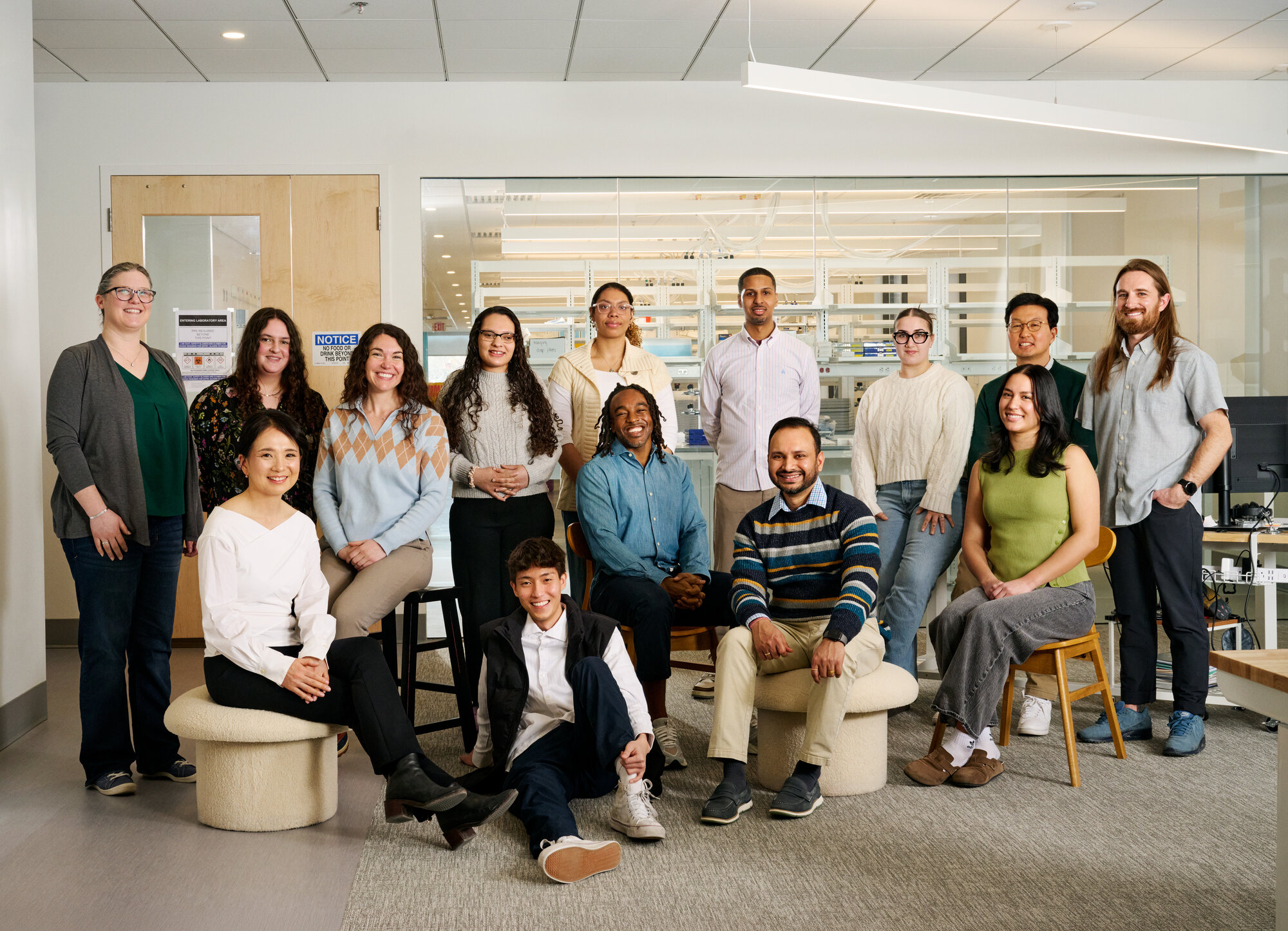
When we met co-founders Nima Alidoust, Ph.D., Johnny Yu, Ph.D., and Hani Goodarzi, Ph.D., we were already speaking the same language. The team shares a perspective we hold deeply and invest behind: drug discovery is only as powerful as the data that fuels it.
Today, the data that informs early drug creation is limited by how researchers generate it. It sits out of context from how disease actually occurs in living organisms. As a result, small-molecule drug development improves slowly and iteratively.
Kevan Shokat, Ph.D., a Vevo co-founder and a renowned professor and inventor at the University of California, San Francisco (UCSF), has experienced this first-hand over decades.
Kevan's pioneering work in medicinal chemistry anchors the team. Nima earned his Ph.D. in computational and in silico chemistry, then led product and research teams at deep-tech and AI startups.
Hani and Johnny bring cancer biology, genomics, and AI expertise from UCSF. Johnny completed his Ph.D. in Hani's lab there.
The most innovative solutions often sit at the intersection of several disciplines. Vevo's founding team of deep domain experts proves the point.
How Mosaic generates in vivo data at single-cell resolution
Vevo has built a way to measure how a drug impacts cells from hundreds of patients. It does this in a single in vivo experiment, at single-cell resolution.
The platform, Mosaic, cracks million-scale data generation on drug-induced changes in gene expression. It uses the most sophisticated disease models available.
Why Wing co-led Vevo Therapeutics' seed round
We are thrilled to co-lead Vevo's $12m seed financing with our respected friends at General Catalyst. A group of collaborators joins us: Mubadala Capital, AIX Ventures, and Camford Capital.
Working with Vevo has been a joy. We are excited to partner with the team and help build toward this new paradigm for drug discovery!
Conclusion
We believe the shift that matters is simple. Start drug discovery with scaled, high-resolution in vivo data rather than saving it for the end. That is the change we're backing in Vevo.
This bet reflects our BioXData thesis: the AI-first transformation of medicine will be built on data. We're excited to partner with the team as they build the world's largest atlas of how chemistry perturbs biology.